The Living Legacy: Connecting the Flanders’ Past to the Present
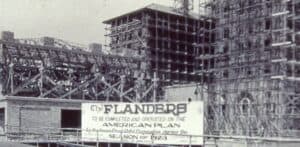
Standing as the “Jewel of the Southern Jersey Shore” since 1923, the Flanders Hotel in Ocean City, New Jersey, is much more than a luxurious seaside retreat. While its Spanish Mission Revival architecture and grand ballrooms often catch the eye of tourists, the building also serves as a living museum of the early 20th century. Some of its most fascinating stories are found in the functional relics hidden within its walls. The private deep-water well, the manual switchboard, and the vintage lobby phone booths offer a glimpse into an era when a grand hotel had to be a self-sustaining city unto itself.
One of the most remarkable, yet often overlooked, feats of engineering at the Flanders is its independent water system. When the hotel was built, the goal was to offer a level of luxury and reliability that exceeded the municipal infrastructure of that era. To accomplish this, the developers commissioned the drilling of an on-site artesian well that remains one of the deepest and oldest in New Jersey. Extending 840 feet below street level, this well taps into an ancient aquifer, providing the hotel with a private water source that is renowned for being crisp and clear.
The workings of this system are a showcase of 1920s practicality. Water is drawn from the depths and treated in a dedicated chlorination station located in the first-floor boiler room. From there, it is not just pumped to the guest rooms; it is sent upward to two large 5,000-gallon storage tanks on the ninth floor. This setup uses gravity to maintain consistent water pressure throughout the building. By adopting this “gravity-fed” approach, the Flanders avoided the need for heavy mechanical pumps that modern buildings rely on for upper floors. To this day, the hotel operates without a city water bill, showing the foresight of its original designers who prioritized independence.
As guests moved through the hotel in the mid-1920s, their connection to the outside world was managed by another marvel of the era: the manual switchboard system. In an age before direct-dialing or digital networking, every single telephone call, whether it was a guest ordering room service or a businessman calling back to Philadelphia, had to pass through the hands of a skilled operator. The Flanders still houses its original switchboard, a complex array of jacks and patch cords that once served as the building’s central nervous system.

The presence of this switchboard reminds modern visitors of the high level of personalized service that characterizes the Flanders. This manual system was not just about technology; it was about human interaction. The operators often knew the guests by name and played a vital role in the daily operations. While the system is no longer the main method of communication, its preservation provides a tangible connection to the history of telecommunications, standing in sharp contrast to the invisible, automated signals we depend on today.
Complementing the internal switchboard are the iconic wood-paneled phone booths located in the lobby. These structures are more than mere furniture; they are architectural artifacts that reflect a time when privacy in public spaces was highly valued. Made from rich, dark wood with heavy glass-paned doors, these booths were designed to provide a soundproof sanctuary for guests. During the hotel’s heyday, these booths were the main way for vacationers to stay connected with their families and businesses.
Today the booths themselves serve as a favorite backdrop for photography and a quiet place for guests to make calls on their mobile devices. There is a certain irony in seeing a guest step into a century-old wooden booth to use a smartphone, yet the booths continue to fulfill their original purpose of providing a private moment in a bustling public hall..
Together, the 840-foot well, the manual switchboard, and the lobby phone booths tell a story of a hotel built to last. These features blend luxury and practicality, showing that the Flanders was designed to be just as functional as it was beautiful. By preserving these relics, the hotel makes sure that its history isn’t just something in books but something guests can see, touch, and pass by every day. The engineering of the past continues to support the hospitality of today, making the Flanders a truly unique landmark in the history of Ocean City and the East Coast.