Life-Saving Stations: Before the Modern Coast Guard
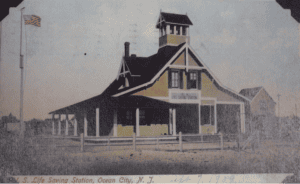
Long before modern radar, GPS, and rescue helicopters, the safety of the Jersey Shore depended on a few brave men, a keen eye, and a wooden rowboat. Today, Ocean City beachgoers see a playground of surf and sun, but a century ago, this coastal area was called a “graveyard of ships.” To face the sea’s constant dangers, a series of sentinels watched over the dunes. These stations belonged to the U.S. Life-Saving Service, the ancestor of today’s Coast Guard, and their heroic story is a key part of Ocean City’s history.
The Storm Warriors: The U.S. Life-Saving Service
The United States Life-Saving Service was officially created in the mid-1800s to combat the high rate of shipwrecks along the American coast. Ocean City’s position on a barrier island made it especially dangerous. Ships traveling the busy routes to New York or Philadelphia frequently encountered dangerous shoals, shifting sandbars, and fierce nor’easters that are characteristic of the New Jersey coast.
These stations were manned by individuals known as “surfmen,” though the public often referred to them as “Storm Warriors.” Their motto was both grim and noble: “You have to go out, but you don’t have to come back.” Positioned every few miles along the coastline, these crews remained perpetually prepared, patrolling the beaches on foot amid relentless rain and snow, vigilantly watching for signals of distressed ships or the outline of a mast against the horizon.
Station 30: The Pride of 4th Street
A key landmark in maritime history is U.S. Life-Saving Station 30 at 4th Street and Atlantic Avenue. Constructed in the 1880s, it was a center of rigorous discipline and exactness. The station’s daily life was shaped by disciplined drills, ensuring rescue operations became instinctive, even during hurricane chaos.
The “Beach Apparatus Drill” was among the most well-known exercises. Surfmen practiced maneuvering a heavy cart, loaded with a small cannon called a Lyle gun, across the soft sand. They aimed to fire a projectile over the masts of a mock wreck, enabling sailors to pull in a heavy rope and escape using a “breeches buoy”—a life ring with canvas “pants” attached. The objective was to set up the entire rescue system and start the operation in less than five minutes. When rough seas prevented the use of the buoy, the men launched large wooden surfboats directly into the breaking waves, a demanding rowing task that required exceptional strength and nerves of steel.

Heroic Rescues: The Legend of the Sea
Ocean City’s lifesavers conducted numerous rescues, but the most remarkable examples of their bravery are seen in their efforts around the frequent wrecks near Great Egg Harbor Inlet. Although the Sindia is the most well-known wreck on the island, it was the smaller, often overlooked schooners that truly challenged the surfmen.
In many cases, Station 30 crews worked overnight in freezing weather, rescuing exhausted sailors from the surf one at a time. Historical records depict surfmen wading chest-deep into the cold Atlantic to reach men holding onto rigging, frequently returning with clothing frozen solid like armor. Their achievements were counted in lives saved; over the years, the Service rescued thousands across the country, often relying solely on oars and hemp rope to face the force of a gale.
Preservation: Keeping the Memory Alive
As technology progressed, the U.S. Life-Saving Service combined with the Revenue Cutter Service in 1915, creating the U.S. Coast Guard. Over time, the wooden stations became outdated, and many were destroyed by storms or development. Nevertheless, Ocean City has actively worked to honor these “Storm Warriors.”
The historic 4th and Atlantic station is a striking example of heritage reuse. Having fulfilled multiple functions over time, including serving as a police station, the building is now preserved as a museum and community space. Visitors can observe architectural details characteristic of a life-saving station, like the large boat-bay doors and the lookout tower.
Preserving these buildings goes beyond saving old wood and shingles; it involves preserving the spirit of self-sacrifice that characterized the island’s early days. Today, standing in front of the old station, one can almost hear the keeper’s commands and the surf crashing, reminding us that our current safety was secured through the bravery of those who once manned these shores.